Baumrind (1991) is well know for his introduction to the four parenting styles known as authoritative, authoritarian, permissive, and neglectful parenting styles. Culture greatly influences the parenting styles one will utilize when raising a child but according to recent studies it has been found that certain styles of parenting can either have a positive or negative affect on a child’s well-being, confidence, and academic performance.
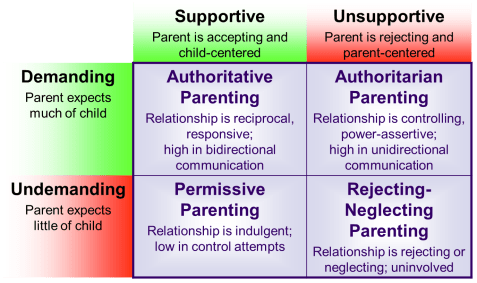
We will be primarily focusing on authoritarian parenting style because it is a topic and practice that continues to be brought up in today’s day and age. Authoritarian parenting style is best described as harsh, demanding, and unresponsive. We see many of these characteristics in the father role. This is because cultures and societies have taught us that the father is the authority figure in the household and must set the rules. The role of the father is to teach their children, especially boys that they need to be tough and have a lack of emotions but authoritarian parenting is not solely dependent on these characteristics. Parents utilizing this style also deny attention and responsiveness to their children. According to Arnett (2010) children raised by authoritarian parents will experience anxiety, low confidence, and a lack of social skills. The video below will further elaborate on the characteristics of the authoritarian parenting style. You will find that these parenting characteristics greatly influences children in a negative aspect, both emotionally and mentally, resulting in undesired behaviors.
Authoritarian Parenting and Academic Performance
Researchers, Rauf’s and Ahmed’s (2017) conducted a study in Pakistan, finding that authoritarian parenting style in eastern countries does not positively influence children and adolescent academic performance. The views and experience on Eastern culture have been known to utilize harsher parenting styles. Children are being pushed to excel academically and it is made apparent that this is the child’s top priority. Children can not strive for their dreams and desires because they are constantly being demanded by their parents to achieve good grades. For example, many of us have seen the scenario of a child from an Asian background being instructed by their parents to either become a doctor, lawyer, or a career with a high status with disregard of what children are truly interested in. Rauf and Ahmed explains that due to these these demands, children strive to have higher grades from fear of their parents but results in low confidence and low self-esteem.

The “Tough Love” video is based in China and focuses on the pressures children are put under by their parents as well as their schools. The video introduces 14 year-old Stephanie. Stephanie goes to an international school where she excels academically and participates in after school programs Monday through Friday, attends music and yoga classes on Saturdays. The adolescents interviewed in the video explain that they continue to revise their work before and after dinner but explain that they do not do as well as expected for all the work they put in, therefore, they must work harder to get into a university. The pressures are extreme and are non-stop. The video also indicates that these pressures of succeeding can result in adolescents in committing suicide if they believe to be inadequate to maintain their parents expectations.
Bullying and Victimization
As we have previously discussed, authoritarian parenting is related to a child’s self esteem and due to further research conducted by Georgiou, Fousiani, Michaelides, and Stavrinides (2013) it has been found that authoritarian parenting is related to bulling and victimization in children. Authoritarian parenting is also associated with competitiveness and striving to be the best out of fear which is now resulting in children in bullying others in order to stay on top and to release their aggression. It was explained that those associated with large groups and competitiveness can result in bullying. Those that are also striving to succeed but do not have the values of being associated with large groups are therefore victims (Georgious, et al., 2013).
In the link provided below, in the movie The Breakfast Club, Andrew the jock confesses to bullying a classmate to promote his status. Andrew also confesses the pressures that he has felt from his father to be cool and to be number one which has resulted in his torturing of his classmate.
Breakfast Club Confession Circle – Authoritarian Parenting
I have also attached a link below that further elaborates on how certain parenting practices influences a child’s chances of bullying others. Suggestions of preventative actions is also provided.
Bullies are not born, they are raised
Authoritarian Parenting in Later Life
Although, authoritarian parenting can affect a child’s life in the moment they are being raised, it was also found that this style of parenting continues to affect those that are now preparing to start a career. Cheung, Cheung, and Wu (2014) found that authoritarian parenting can hinder a child’s career readiness because of the anxiety a student experiences. Much of this anxiety is brought upon the way these students were raised. A problem that will arise from anxiety is the fear of committing and moving forward to the next step. Students experience behavior inhibitions which is a result of authoritarian parenting and can inhibit a student’s career exploration (Cheung, et al, 2014).
I have selected Symbolic Interaction theory to further explain how authoritarian parenting affects children. Symbolic Interaction presented between children and parents symbolizes that their is a close relationship which is relevant to all cultures. Children are dependent and trusting of their parent. When is child is treated with harsh demands a child begins to feel pressure to achieve what their parent instruct them to do. Along with this, children will not receive acceptance of what they truly desire by their parents. Children will begin to have low self-esteem and confidence because their parents will consistently tell them what they are doing is not good enough.
Many studies have been and are continued to be conducted in order to find the affects of the authoritarian parenting style. With enough evidence and awareness of the negative affects of authoritarian parenting, cultures and societies might think twice about the parenting styles they practice on their children.
I chose this topic because I am currently at the stage where I am able to identify the outcomes of these parenting styles. I have seen many friends and acquaintances, including myself that have experienced authoritarian parenting and have determined that their are more negative outcomes than positive. I have seen friends fearful and stressed of what their parents will think if they do not obtain a degree in time. I have seen others that deal with anxiety due to the their parents constantly demanding and expecting more from them. Authoritarian parenting does not conclude that children will excel in school or be ready to explore the endless possibilities offered to them, and it will most definitely not prevent them from reaching the top without hurting someone else just for their parents to be proud of them.
References
Arnett J.J. (2010). Upper Saddle River,NJ: Adolescence and Emerging Adulthood. Prentice Hall, Pearson.
Cheung, C.-K., Cheung, H. Y., & Wu, J. (2014). Career unreadiness in relation to anxiety and authoritarian parenting among undergraduates. International Journal of Adolescence & Youth, 19(3), 336–349. https://doi-org.lib-proxy.fullerton.edu/10.1080/02673843.2014.928784
Georgiou, S. N., Fousiani, K., Michaelides, M., & Stavrinides, P. (2013). Cultural value orientation and authoritarian parenting as parameters of bullying and victimization at school. International Journal of Psychology, 48(1), 69–78. https://doi-org.lib-proxy.fullerton.edu/10.1080/00207594.2012.754104
Rauf, K., & Ahmed, J. (2017). The Relationship of Authoritarian Parenting Style and Academic Performance in School Students. Pakistan Journal of Psychology, 48(2), 61–71. Retrieved from http://search.ebscohost.com.lib-proxy.fullerton.edu/login.aspx%3fdirect%3dtrue%26db% 3daph%26AN%3d129038839%26site%3dehost-live%26scope%3dsite
Cheung, C.-K., Cheung, H. Y., & Wu, J. (2014). Career unreadiness in relation to anxiety and authoritarian parenting among undergraduates. International Journal of Adolescence & Youth, 19(3), 336–349. https://doi-org.lib-proxy.fullerton.edu/10.1080/02673843.2014.928784
Photos
https://my.vanderbilt.edu/developmentalpsychologyblog/2013/12/176/
https://academichelp.net/wp-content/uploads/2015/04/parent-yelling-at-child

 Family Project